2024-1-RO01-KA131-HED-000198346-2
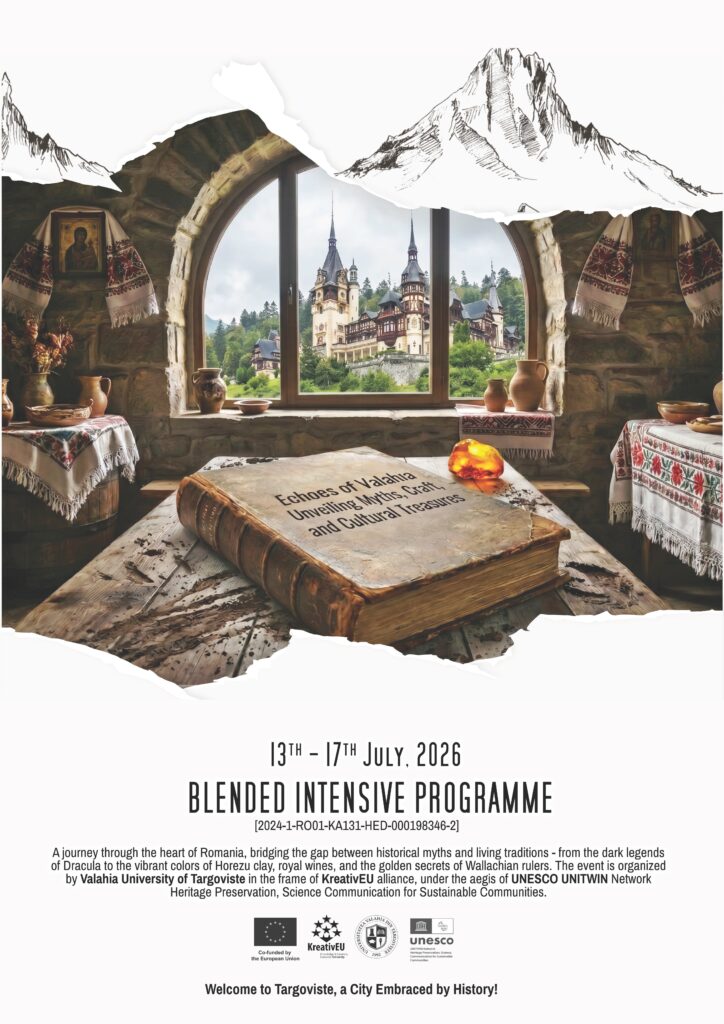
Blended Intensive Programme
Echoes of Valahia – Unveiling Myths, Craft, and Cultural Treasures
13th – 17th July, 2026
A journey through the heart of Romania, bridging the gap between historical myths and living traditions – from the dark legends of Dracula to the vibrant colors of Horezu clay, royal wines, and the golden secrets of Valahia (Wallachian) rulers.
The event is organized by Valahia University of Targoviste, within the framework of the KreativEU Alliance, under the aegis of the UNESCO UNITWIN Network, Heritage.
Welcome to Târgoviște, a City Embraced by History!
Objectives & Description
The Blended Intensive Programme (BIP): “Echoes of Valahia – Unveiling Myths, Craft, and Cultural Treasures” is designed to immerse participants in the historical and cultural heart of south-Romania, trying to bridge the gap between myths, folklore, traditions, and tangible heritage. By traversing various landscapes – from vast fields to high mountains, from the medieval ruins of Târgoviște to the mysteries that surround the areas of Buzău and Horezu -, the participants have the opportunity to explore how identity is preserved through architecture, craft, storytelling, and past and present colors.
The programme proposes a journey in time, starting with historical artefacts, continuing by exploring a multitude of traditions, and ending with sparkling landscapes and living horizons. The proposed curriculum integrates UNESCO’s heritage principles with key European Union cultural and policy priorities, including heritage-led innovation, participatory governance, and sustainable and responsible tourism. A particular emphasis is placed on: (a) cultural decoding – enabling participants to identify and analyze the intersection of myths, Christian, especially Christian Orthodox spirituality and its ecumenical and dialogical ethos, and royal heritage in the Valahian culture; (b) artisanal preservation – facilitating the deep understanding of traditional Romanian crafts (pottery, amber processing, viticulture) as sustainable economic and cultural assets; (c) interdisciplinary eco-cultural perspectives – encouraging the integration of geology, geography, history, arts, ethnography into a cohesive narrative of Valahian regional identity; (d) collaborative innovation – fostering international academic networks through joint problem-solving and comparative cultural studies.
Cultural diversity is framed at the heart of the programme, being approached according to UNESCO’s understanding of cultural heritage stewardship as a shared responsibility between institutions, communities, and future generations. Participants are immersed in various environments of Valahia region, with their own traditions and particularities: (a) Târgovişte and surroundings – the former capital of Valahia, and a well-known landscape of political and princely authority; (b) Western Buzău region (also part of the Buzău Land UNESCO Global Geopark) – famously for its wild, otherworldly geological phenomena and its rare, native fossilized resin; (c) Prahova Valley corridor – a breathtaking Carpathian mountains scenery and real royal heritage; (d) Horezu area – the cultural heart of Oltenia (western Valahia), with its Romania unique UNESCO-listed pottery, medieval defensive architecture, rich folk arts, and hearty traditional cuisine.
The BIP proposes a one-week intensive journey beginning with a virtual preparatory phase (blended component) followed by a physical intensive week in southern Romania. The itinerary comes as a journey through time and traditions – from the grandeur of Peleș Castle and the Azuga Royal Cellars to the monastic serenity of Sinaia, Dealu, and Viforâta monasteries, toward the “living heritage” of the Horezu area – smelling the perfume of the local pottery houses -, alongside the fortified Maldarăști Kulas, and deep inside the geological wonders of the Muddy Volcanoes, and the rare exhibits of the Amber Museum, mixed with the architectural Brâncovenesc (Brancovan) style elegance of the Potlogi Palace and Golești Domain.
By promoting valuable pieces of the World Heritage, together with broader debates on responsibility, transmission, and intergenerational equity, the programme encourages participants to view heritage stewardship as an ethical and civic commitment to cultural diversity, resilience, and a sustainable future.
Methods & Outcomes
The programme envisages a blended, interdisciplinary, and comparative methodology that combines theoretical instruction, collaborative learning, and applied case-based analysis. Teaching and learning methods are explicitly aligned with UNESCO’s values, KreativEU principles of eco-cultural heritage stewardship and the EU’s policy framework on sustainable development, cultural diversity, and inclusive governance.
During the virtual phase, participants engage with guided readings and an interactive seminar focused on key aspects and concepts related to the contemporary approaches of the living heritage, values of cultural treasures, and sustainable communities. The session introduces the myths and craft framework, the valorization of Valahia landscapes and memories as a value-based heritage assessment and participatory governance models. Online discussions and small-group assignments foster critical reflection and transnational exchange, enabling participants from different academic and cultural backgrounds to develop a shared conceptual basis.
The physical mobility phase – set up on this foundation – proposes site visits, guided fieldwork, stakeholder meetings, and workshops organized in the visited sites. To ensure academic rigor, the programme employs a methodological framework oriented on: (a) interdisciplinary comparative analysis – participants will use “trans-historical lens” (by example, to evaluate and compare the Brâncovenesc style (Potlogi, Hurez) with the Western influences found in Peleș Castle). More, discussions will bridge the gap between geology (Muddy Volcanoes) and local folklore to see how natural phenomena inspire “landscape myths”; (b) applied case-based analysis – instead of passive tours, workshops at the Horezu pottery houses and the Amber Museum will function as live case studies (participants will analyze the “life cycle” of a craft – from raw material (clay/ resin) to cultural issues – assessing the challenges of preservation in a modern economy).
As a result of participating in the programme, participants are expected to achieve a set of defined learning and competence-based outcomes. In this respect, they develop a solid understanding of theories, concepts, and policy frameworks related to cultural heritage stewardship, with particular reference to UNESCO and European Union approaches, being able to: (a) apply UNESCO’s stewardship principles by assessing the proposed case studies; (b) compare different models of cultural heritage management across diverse historical, cultural, and governance contexts; (c) evaluate the role of communities, cultural diversity, and participatory governance in sustainable heritage practices; (d) identify challenges related to overtourism, climate risk, social inclusion, and economic sustainability on historic sites, and propose context-sensitive responses.
On the other hand, it is expected that all participants will enhance their intercultural competences, concerning their abilities to navigate and respect complex regional history through shared field experiences.
On a transversal level, the programme strengthens competencies in intercultural communication, collaborative problem-solving, and transnational cooperation. Participants gain practical experience in interdisciplinary teamwork and develop a heightened awareness of cultural diversity and ethical responsibility in heritage-related decision-making.
Date of virtual component: 08.07.2026
Description: The virtual component of the BIP is designed as an interactive, collaborative space where participants build foundational knowledge, share perspectives, and set the stage for their upcoming physical mobility. Through expert-led presentations, group discussions, and digital showcases, participants will immerse themselves in the rich tapestry of Wallachian identity.
The virtual sessions are structured around several interconnected themes that bridge historical legacy with modern preservation:
(a) Contemporary Approaches to Living Heritage – this segment explores how traditional knowledge, rituals, and customs are being preserved, adapted, and revitalized nowadays. Participants will discuss the challenges of safeguarding intangible heritage in a rapidly modernizing world and examine ways to preserve it in a community-led manner.
(b) Myths and Crafts of Valahia – this module unveils the foundational legends, folklore, and symbolic motifs that have shaped the regional conscience. More, the narratives and presentations will showcase the region’s traditional crafts, revealing how artisans encode cultural identity into physical objects.
(c) Cultural Treasures of the Region – the segment will highlight iconic monasteries, royal courts, and art collections. Participants will analyze those treasures not just as monuments of the past, but as anchors for regional identity and assets for sustainable cultural tourism.
(d) Landscapes and Memories of Valahia – this thematic pillar examines the cultural landscapes and how memory is mapped onto the terrain. Participants will explore oral histories, local memoirs, and collective memories that transform ordinary geography into a deeply storied landscape.
In this respect, the objectives of the virtual component are oriented on: (a) establishing cross-cultural academic networks between participants; (b) equipping participants with the theoretical and historical frameworks necessary to fully appreciate the on-site field experiences; (c) initiating the participants in the collaborative tasks that will be held during the physical mobility phase.
By establishing a shared conceptual and analytical vocabulary, the virtual phase provides participants with the tools needed to assess diverse heritage management models, understand their cultural and political contexts, and prepare for comparative, case-based explorations during the physical mobility phase of the programme.