

Call for Participation
About the Programme
Valahia University of Târgoviște, in collaboration with the KreativEU Alliance of European Universities, Trnava University in Trnava and D. A. Tsenov Academy of Economics, in partnership the UNESCO UNITWIN Network „Heritage Preservation, Science, Communication for Sustainable Communities”, invites you to join a prestigious academic initiative focused on Europe’s historic urban environments.
This programme is financed by the European Union and aligns with UNESCO’s mission to promote sustainable development, safeguard cultural heritage, and enhance intercultural dialogue, positioning cultural heritage as a key driver of urban transformation.
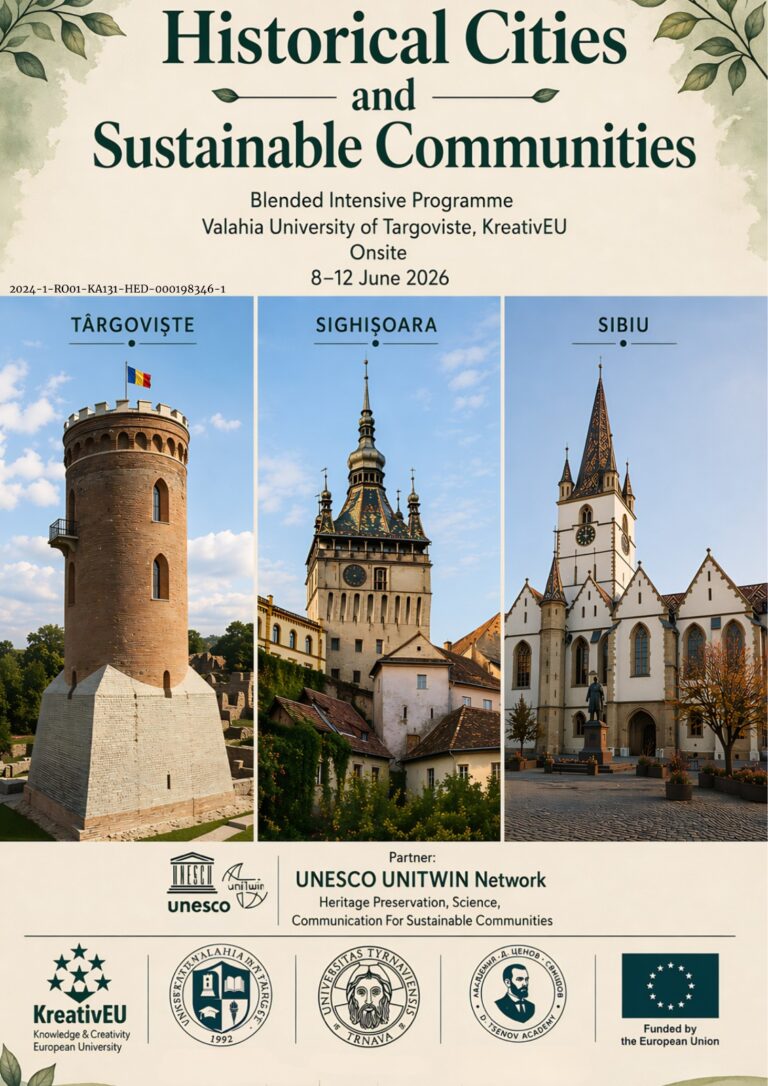
Participants will engage in online preparatory modules followed by immersive learning experiences in three culturally significant Romanian cities. Accommodation will be provided in Târgoviște (Days 1–2) and Sighișoara (Days 3–4), culminating in a field visit to Sibiu (Day 5).
Programme Overview
Historical Cities and Sustainable Communities explores urban cultural heritage as a catalyst for:
- Sustainable development
- Economic innovation
- Cultural vitality
- Community resilience
The programme integrates UNESCO’s heritage principles with the EU’s cultural priorities:
- Heritage-led innovation
- Community participation
- Sustainable tourism
- Inclusive urban regeneration
- Cross-border cooperation
- Digital transformation
- Climate-aware heritage management
Aims of the Programme
Historical Cities and Sustainable Communities examines urban cultural heritage as a powerful catalyst for sustainable development, economic innovation, cultural vitality, and community resilience. The programme approaches historic cities not as static repositories of the past, but as living urban environments in which heritage actively informs contemporary life and shapes forward-looking development trajectories.
The curriculum integrates UNESCO’s heritage principles with key European Union cultural and policy priorities, including heritage-led innovation, participatory governance, sustainable and responsible tourism, and inclusive urban regeneration. Particular emphasis is placed on meaningful community engagement, cross-border and transnational cooperation, and the strategic use of digital technologies to enhance access to, interpretation of, and stewardship over cultural heritage. At the same time, the programme promotes climate-aware heritage management by addressing environmental risks and encouraging adaptive strategies that strengthen the long-term resilience of historic urban areas while ensuring social inclusion and economic viability.
Cultural diversity lies at the heart of the programme and is approached in line with UNESCO’s understanding of cultural heritage stewardship as a shared responsibility between institutions, communities, and future generations. Participants engage with cities from different regions of Romania, each shaped by distinct historical trajectories, governance traditions, and cultural identities. These include Târgovişte, the former capital of Wallachia and a centre of political and princely authority; Sibiu (Hermannstadt), a medieval urban hub and former capital of Transylvania, shaped by centuries of Saxon civic traditions; and Sighişoara (Schäßburg), historically characterised by a strong German-speaking community and a remarkably well-preserved medieval townscape.
Through the comparative exploration of these urban contexts, participants gain insight into diverse models of cultural heritage management, reflecting UNESCO’s emphasis on context-sensitive, inclusive, and value-based stewardship. The case studies highlight how heritage is not merely conserved as a material asset, but actively negotiated as a living resource, shaped by social practice, memory, and identity. Particular attention is given to the ways in which local communities act as custodians of heritage, contributing traditional knowledge, intangible cultural practices, and participatory governance structures that are central to UNESCO’s people-centred approach to heritage management.
Sighişoara offers a particularly significant illustration of UNESCO stewardship principles in practice, with its historic centre designated as a UNESCO World Heritage Site. This case enables critical reflection on the opportunities and challenges of World Heritage governance, including balancing conservation with contemporary urban needs, managing tourism pressures, and ensuring that heritage protection contributes to social cohesion and economic sustainability rather than exclusion or commodification. By situating World Heritage designation within broader debates on responsibility, transmission, and intergenerational equity, the programme encourages participants to view heritage stewardship not as a technical exercise alone, but as an ethical and civic commitment to cultural diversity, resilience, and sustainable urban futures.
Theories and Concepts
The virtual component of the BIP will be devoted to the theoretical and conceptual foundations underpinning the study of historical cities and sustainable communities. It introduces participants to key frameworks that interpret urban cultural heritage as a living, dynamic system, embedded in social
practice, governance structures, and long-term development processes rather than as a static legacy of the past.
Central to this part of the programme is UNESCO’s people-centred approach to cultural heritage stewardship, including the principles of the Historic Urban Landscape (HUL) recommendation. These perspectives emphasise the integration of heritage conservation with sustainable urban development, participatory governance, and intergenerational responsibility. Participants will explore how heritage values, tangible and intangible, are identified, negotiated, and transmitted through shared stewardship involving public authorities, civil society, local communities, and cultural practitioners.
The virtual modules will also engage with broader theories of sustainability, resilience, and place-based development. Topics include heritage-led regeneration, cultural diversity and identity, community resilience in historic urban environments, and the role of culture in fostering social cohesion and economic vitality. Particular attention is paid to ethical dimensions of heritage management, such as inclusivity, social justice, and the balance between conservation, tourism, and everyday urban life.
By establishing a shared conceptual and analytical vocabulary, the virtual phase provides participants with the critical tools needed to assess diverse heritage management models, understand their cultural and political contexts, and prepare for comparative, case-based explorations during the physical mobility phase of the programme.
Methods and Results
The programme employs a blended, interdisciplinary, and comparative methodology that combines theoretical instruction, collaborative learning, and applied case-based analysis. Teaching and learning methods are explicitly aligned with UNESCO’s principles of eco-cultural heritage stewardship and the EU’s policy framework on sustainable development, cultural diversity, and inclusive governance.
During the virtual phase, participants engage with guided readings and interactive seminar focused on key theories and concepts related to historical cities, sustainable communities, and heritage management. This session introduces analytical tools such as the Historic Urban Landscape (HUL) framework, value-based heritage assessment, and participatory governance models. Online discussions and small-group assignments foster critical reflection and transnational exchange, enabling participants from different academic and cultural backgrounds to develop a shared conceptual vocabulary.
The physical mobility phase builds upon this foundation through experiential and place-based learning. Methods include guided fieldwork, site visits, stakeholder meetings, and workshops conducted in selected historic cities. Participants analyse real-world heritage contexts, governance structures, and community practices, applying theoretical frameworks to concrete urban environments. Comparative group work encourages participants to assess differing approaches to conservation, tourism management, climate adaptation, and community involvement across the case-study cities.
Throughout the programme, emphasis is placed on collaborative learning, reflective practice, and problem-based approaches. Participants work in mixed international teams, produce short analytical outputs, and engage in moderated discussions that link local observations to global heritage debates.
Digital tools are also used to support documentation, interpretation, and collaborative analysis, reflecting contemporary practices in heritage research and management.
As a result of participating in the programme, students are expected to achieve a set of clearly defined learning and competence-based outcomes. Academically, participants will develop a solid understanding of key theories, concepts, and policy frameworks related to historical cities, sustainable communities, and cultural heritage stewardship, with particular reference to UNESCO and European Union approaches.
Participants will be able to:
Critically analyse historic urban environments as dynamic systems shaped by cultural, social, economic, and environmental processes;
- Apply UNESCO’s stewardship principles and the Historic Urban Landscape approach to the assessment of concrete case studies;
- Compare different models of cultural heritage management across diverse historical, cultural, and governance contexts;
- Evaluate the role of communities, cultural diversity, and participatory governance in sustainable heritage practices;
- Identify challenges related to tourism pressure, climate risk, social inclusion, and economic sustainability in historic cities, and propose context-sensitive responses.
On a transversal level, the programme strengthens competencies in intercultural communication, collaborative problem-solving, and transnational cooperation. Participants gain practical experience in interdisciplinary teamwork and develop a heightened awareness of cultural diversity and ethical responsibility in heritage-related decision-making.
Overall, the programme contributes to forming a new generation of scholars and practitioners who understand cultural heritage as a shared responsibility and a strategic resource for sustainable urban futures, capable of translating international heritage principles into locally grounded and socially inclusive practices.
Online Activity
3 June 2026.
On Site Activities
Târgoviște (Days 1–2)
A rich tapestry of Medieval and Early Modern heritage.
Academic debates on:
– Historical Cities
– Sustainable Communities
Site visits to heritage locations.
Sighișoara (Days 3–4)
Famed for being a UNESCO World Heritage Site.
– Roundtable discussions on local identity and sustainability.
– Guided site visits exploring conservation and tourism impacts.
Sibiu (Day 5)
A hub of cultural and historical integration.
– Field visits to cultural sites.
– Exploration of adaptive reuse strategies.
Academic Themes
– Urban heritage as a sustainable development catalyst
– Participatory heritage governance
– Heritage-led urban regeneration
– Climate-aware city management
– Responsible cultural tourism
– Case studies of heritage valorisation
Intended Participants
We invite:
– University professors and researchers
– Heritage and cultural managers
– Professionals in sustainable development, economics, public administration, urban studies, tourism, and related fields
Scholarly & Professional Benefits
Participants will:
– Gain expertise in heritage and sustainable development
– Strengthen interdisciplinary skills
– Engage with UNESCO and EU frameworks
– Conduct fieldwork in historic cities
– Join a community dedicated to sustainable heritage development
Application Requirements
Please fill out this form by 4 May 2026.
Join Us
Be part of this unique academic endeavour and contribute to shaping the future of Europe’s historic cities. Your involvement will enhance sustainability, cultural vitality, and community resilience, reflecting the shared missions of UNESCO and the European Union.